Tube Laser Cutting
Tube and pipe laser cutting job work in Vadodara: cut to length, holed, slotted, notched and coped in one setup.
- Process
- CNC fiber tube laser
- Sections
- Round · square · rectangular · oval; angle and channel on request
- Materials
- MS · SS · aluminium
- Features
- Holes · slots · notches · copes · mitres · tab-and-slot
Overview
Tube laser cutting cuts tubes and pipes to length and adds holes, slots, notches and copes in one setup, so parts fit together accurately for welding or bolting with no drilling or marking out. It suits furniture and frame parts, handrails, racks, trolleys, machine frames and structural members, from a few pieces to repeat batches.
Our capabilities
- 01Cut-to-length, holes, slots and notches in one setup
- 02Saddle and fish-mouth copes for tube joints
- 03Tab-and-slot joints for faster welding
- 04Round, square and rectangular sections
- 05Repeatable batches from saved programs
- 06Ready for bending, welding and coating
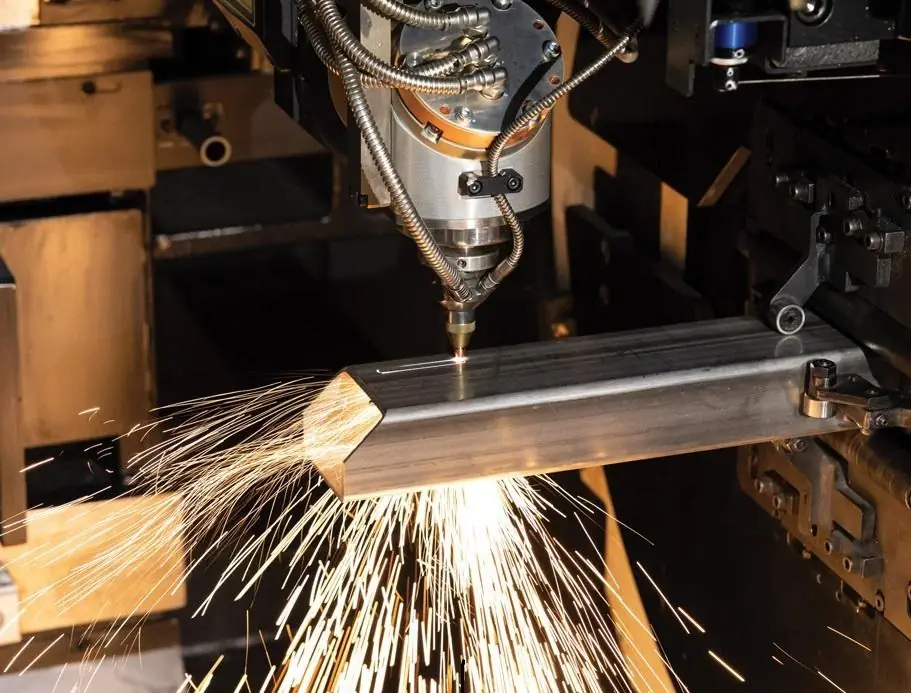
What tube laser cutting does
A tube laser holds the tube in a rotating chuck and turns it under the cutting head, so it can cut on every face and around the full profile. The result is a finished tube part, cut to length with all its holes, slots, notches and copes, ready for bending, welding or bolting, without marking out, drilling or deburring.
Cuts and features
- 01Cut to lengthSquare or angled ends cut from stock lengths, nested to save material.
- 02Holes and slotsRound, oval and shaped holes on any face of the tube, in one setup.
- 03Notches for bendingV-notches and relief cuts so a tube folds into a frame with one weld.
- 04Saddle and fish-mouth copesProfiled ends that sit tightly on a round tube for clean T- and Y-joints.
- 05MitresStraight and compound mitres for corners and frames that close accurately.
- 06Tab-and-slot jointsSelf-locating parts that hold themselves square, so frames need fewer jigs.
- 07IntersectionsCross joints and through-slots where tubes pass through each other.
- 08Etched marksPart numbers and bend or weld locations marked on the tube during cutting.
Sections and materials
| Section | Typical size range | Typical uses |
|---|---|---|
| Round tube and pipe | about 12 to 220 mm OD | ERW and seamless pipe, conduit, handrail tube |
| Square hollow section | about 12 to 200 mm | Frames, furniture, racks, gates |
| Rectangular hollow section | about 10 × 20 to 200 × 150 mm | Chassis, trolleys, machine frames |
| Oval and D-shaped tube | On request | Furniture and decorative work |
| Angle and channel | On request | Brackets, supports and structural members |
| Material | Typical wall thickness |
|---|---|
| Mild steel (MS) | up to about 10 to 12 mm |
| Stainless steel (SS) | up to about 6 mm |
| Aluminium | up to about 4 mm |
Size ranges are typical for tube laser cutting. Send your section size, wall thickness and length, and we confirm what suits your job in the quote.
Tube laser vs saw and drill
| Step | Saw, mark and drill | Tube laser |
|---|---|---|
| Cutting to length | Band saw, one cut at a time | Cut by the laser, ends square or angled |
| Holes and slots | Marked out by hand, then drilled | Cut in the same setup, located by the program |
| Copes and notches | Ground or milled with fixtures | Cut directly, any profile |
| Deburring | Separate operation | Clean edge, minimal finishing |
| Fit-up for welding | Needs jigs and measuring | Tab-and-slot parts locate themselves |
| Repeat orders | Set up again each time | Same saved program, same result |
Where tube laser cut parts are used
- FurnitureTable, chair, bed and office furniture frames
- Gym and fitness equipmentRacks, benches and machine frames
- Railings and gatesBalcony, stair and gate tube work
- Solar mounting structuresPurlins, legs and bracing members
- Racks and storageShelving, display and warehouse racks
- Trolleys and material handlingTrolley frames, cages and carts
- Automotive and two-wheelerBrackets, guards and frame members
- Agricultural machineryImplement frames and tube supports
- Machine frames and guardsBases, enclosures and safety guarding
- Process and food equipmentSS tube stands, frames and supports
Design tips for tube parts
- Send a STEP model of the finished tube part where you can; it carries every hole and cope exactly.
- State the section size, wall thickness and material grade, and the stock length if you supply the tube.
- Keep holes at least as large as the wall thickness, and keep features a little away from the tube ends.
- Mark where the weld seam may sit if a face must stay seam-free for appearance or fit.
- For tab-and-slot frames, leave a small clearance in the slots so parts slide together after cutting.
- Tell us about later steps (bending, welding, powder coating) so we cut notches and marks to suit.
Technical data
| Process | CNC fiber tube laser |
|---|---|
| Sections | Round · square · rectangular · oval; angle and channel on request |
| Materials | MS · SS · aluminium |
| Features | Holes · slots · notches · copes · mitres · tab-and-slot |
| Typical tolerance | About ± 0.2 to 0.3 mm, section dependent |
| Files | STEP (best) · IGES · DXF · DWG · PDF |
| Quantities | Prototypes to repeat batches |
| Next steps in-house | Bending · welding · powder coating |
Values reflect common industry practice and referenced standards. Final values are set by your drawings and specification.
Our project approach
- 01
Submit drawings & specs
Send your drawings, specifications and quantities. DXF, DWG, STEP or PDF.
- 02
Proposal
A clear technical and commercial proposal with price, scope and delivery date.
- 03
Manufacturing
Fabrication, finishing and inspection to the agreed quality plan.
- 04
Shipping, delivery & local assembly
Delivered to your site, with assembly and installation support locally.
FAQs
What sections can be tube laser cut?
Round, square and rectangular tubes and pipes in mild steel, stainless and aluminium. Send the section size, wall thickness and length with your drawing and we confirm what suits the job.
Why use tube laser cutting instead of sawing and drilling?
A tube laser cuts to length and adds every hole, slot and notch in one setup, so parts are repeatable and fit up accurately for welding. It removes marking out, drilling and deburring steps, which saves time on batches.
What tolerance can tube laser cutting hold?
Tube laser cutting typically holds around ± 0.2 to 0.3 mm on features, depending on the section, wall thickness and the straightness of the tube itself. Tell us any critical dimensions and we will confirm them in the quote.
Can tube laser cut parts be bent and welded afterwards?
Yes. Notches and marks can be cut so the tube folds into a frame, and parts can go straight on to bending, welding and powder coating in our plant.
Do you supply the tube or cut my material?
Either. We can buy the tube to your grade and size, or cut tubes you supply. Tell us which when you send the drawing.
Which file should I send for tube laser cutting?
A STEP model of the tube part is best. A dimensioned PDF or DXF of each face also works; our engineers will prepare the program and confirm it with you.
Who manufactures the parts?
Everything is engineered and made in-house at our own plant. We are part of the Ferrokshar Group, in production since 1997.
Who do I deal with?
Our engineering team is your single point of contact, from quote to delivery and after-sales service.
Request a quote
Send your drawings and specifications. Our engineers will reply with a detailed proposal.